
Editor’s Note
At Puredietly, our mission is to simplify complex metabolic science for our readers. The “Inversion of Sugar” is a topic that sits at the intersection of culinary art and nutritional chemistry. While this article explores how invert sugar enhances food texture, we encourage our community to view all added sweeteners through the lens of metabolic health. This post is part of our ongoing series on “Hidden Ingredients” to help you navigate the modern food landscape with confidence.
Introduction: Why Should You Care About Invert Sugar?
If you have ever wondered why some desserts stay incredibly soft for days or why professional ice cream is never “gritty,” you have already witnessed the power of inversion of sugar. In the world of metabolic health and culinary science, understanding how sugar transforms is vital. For our USA audience—where processed foods often hide different types of sweeteners—knowing exactly what “invert sugar” is can help you make better dietary choices.
In this comprehensive guide, we will explore the science behind sugar inversion, its role in the food industry, and most importantly, its impact on your blood glucose levels.
1. The Science: What is Sugar Inversion?
At its core, inversion of sugar is a chemical process that breaks down sucrose (regular table sugar) into its two building blocks: glucose and fructose.
The Process of Hydrolysis
Table sugar is a “disaccharide,” meaning it consists of two molecules bonded together. Through a process called hydrolysis—usually triggered by heat and an acid (like citric acid or cream of tartar)—this bond is broken.
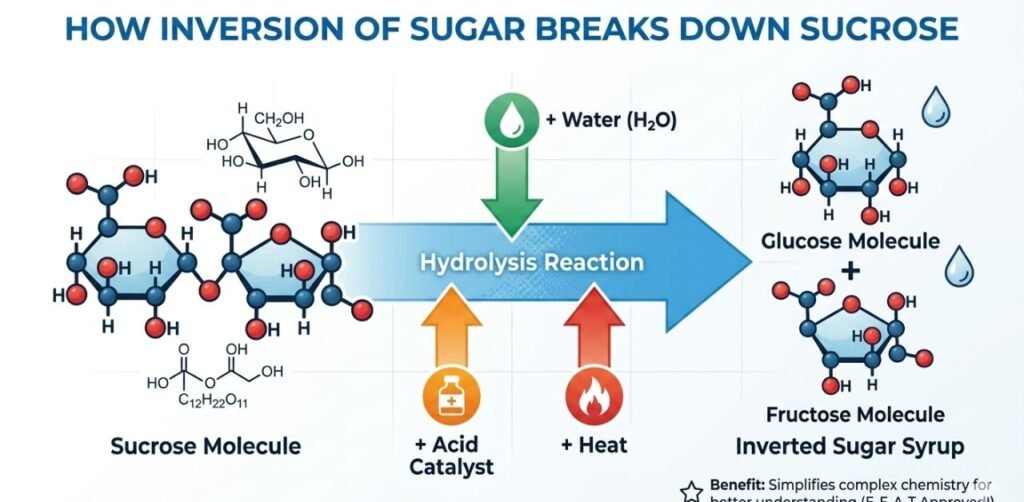
- Sucrose + Water + Acid/Heat = Invert Sugar
The resulting syrup is a 50/50 mix of free-floating glucose and fructose. It is called “inverted” because of how it reacts to light in a laboratory setting. While sucrose rotates polarized light to the right, the newly formed mixture rotates it to the left (inverts it).
2. Invert Sugar vs. Table Sugar: A Comparison
While they start from the same place, their physical and chemical properties are worlds apart.
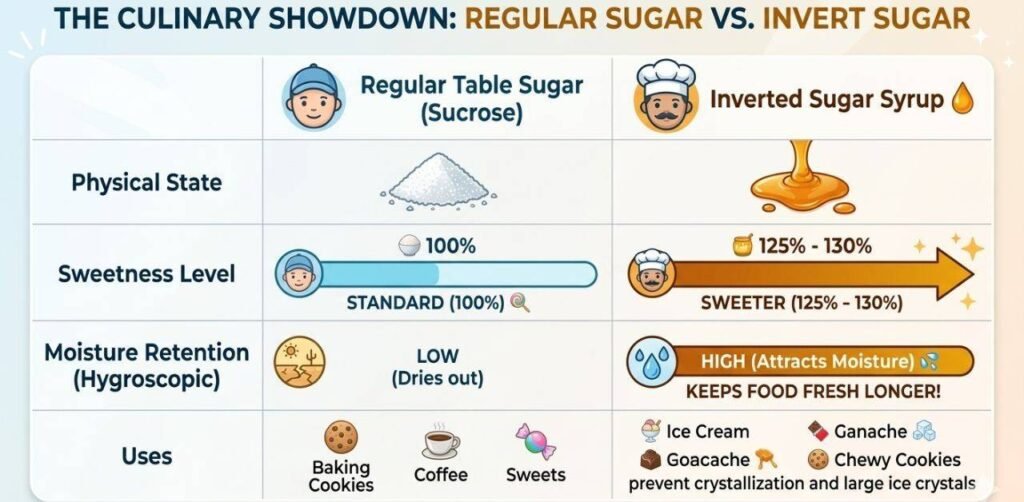
| Feature | Regular Table Sugar (Sucrose) | Inverted Sugar Syrup |
| Physical State | Crystalline solid | Thick, honey-like liquid |
| Sweetness Level | 100% (Standard) | 125% – 130% (Sweeter) |
| Hygroscopic? | Low (Dries out) | High (Attracts moisture) |
| Crystallization | High (Forms grains) | Extremely Low (Stay smooth) |
| Solubility | Needs heat to dissolve | Dissolves instantly in cold liquids |
3. Why the Food Industry Uses It (Culinary Benefits)
Professional bakers and large-scale food manufacturers in the USA use invert sugar as a “functional” ingredient. It isn’t just for sweetness; it’s for performance.
A. Texture and Moisture Retention
Invert sugar is a humectant. This means it acts like a sponge, pulling moisture from the air into the food. This is why a store-bought muffin stays moist for a week while a home-baked one might get hard by day two.
B. Prevention of Crystallization
In candy making and chocolate production (like ganache), sugar crystals are the enemy. Because invert sugar is already broken down, it prevents other sugar molecules from bonding together and becoming “grainy.”
C. Smoother Frozen Desserts
In ice cream and sorbet, invert sugar lowers the freezing point. This prevents large ice crystals from forming, ensuring every spoonful is velvety smooth.
4. Metabolic Audit: Is Invert Sugar “Healthy”?
Since puredietly.com focuses on metabolic health, we must look at how this sugar affects your body differently than regular sugar.
The Glycemic Impact
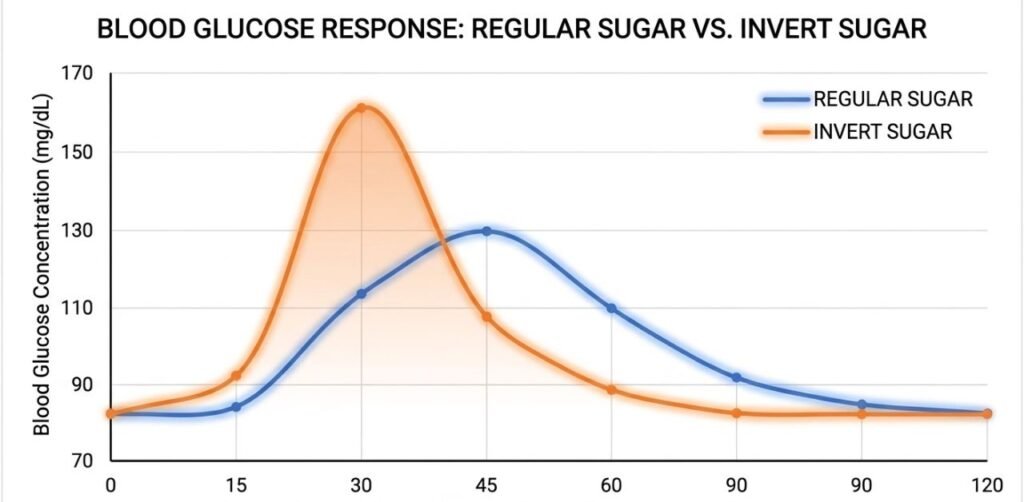
Technically, invert sugar contains the same amount of glucose and fructose as table sugar. However, because it is already “pre-digested” (the chemical bond is already broken), the body absorbs it slightly faster.
- Insulin Response: Since the glucose is free-form, it can cause a more rapid spike in blood sugar compared to complex carbohydrates.
- The Fructose Factor: Free fructose is metabolized in the liver. Excessive intake can lead to fatty liver issues, similar to high-fructose corn syrup (HFCS).
The “Less is More” Paradox
Interestingly, because invert sugar is roughly 25% sweeter than table sugar, manufacturers can theoretically use less of it to achieve the same sweetness. This could slightly reduce the total caloric load, but the difference is usually negligible for someone managing diabetes.
Sentence: “Knowing exactly what ‘invert sugar’ is can help you make better dietary choices, similar to how we analyzed other [Sugar Substitutes like Allulose].”
5. Identifying Invert Sugar on USA Food Labels
In the United States, the FDA requires ingredients to be listed by weight. You might not always see “Invert Sugar” on the label. Look for these Semantic (LSI) Keywords:
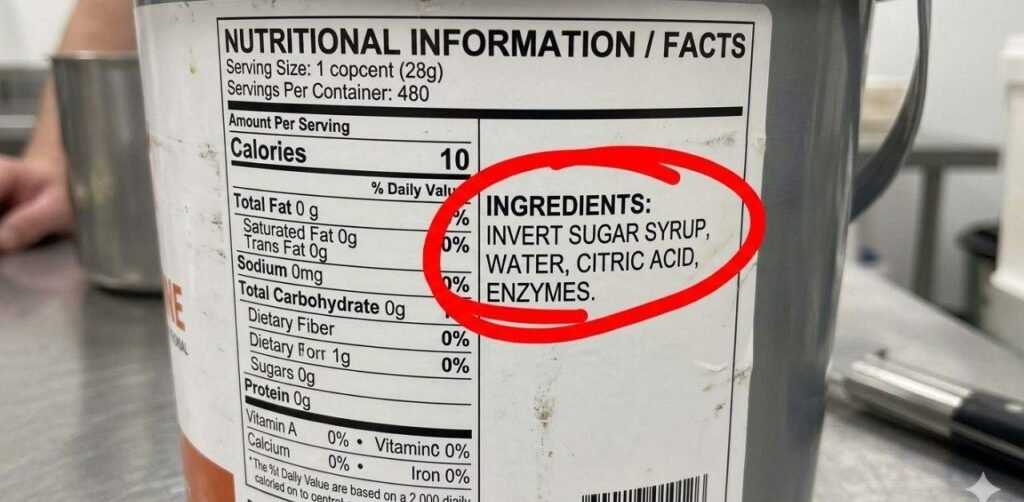
- Trimoline (Commercial brand)
- Inverted Sugar Syrup
- Artificial Honey
- Brewing Sugar
- Isoglucose
For those following a strict metabolic diet, seeing these names should be a signal that the product is highly processed and likely to have a high glycemic impact.
6. DIY: How to Make Invert Sugar at Home
If you are a home baker wanting to experiment with professional textures, you can make a small batch easily.
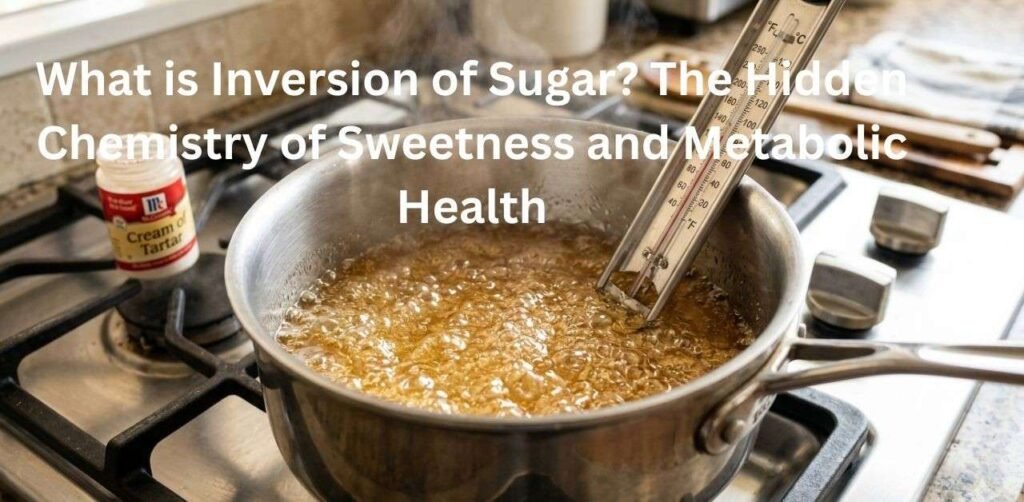
Ingredients:
- 2 lbs Granulated White Sugar
- 1 pint Water
- 1/4 tsp Citric Acid or Cream of Tartar
Directions:
- Combine ingredients in a heavy-bottomed pot.
- Heat slowly while stirring until the sugar dissolves.
- Increase heat and bring to a simmer (do not stir once it boils).
- Use a candy thermometer to reach 236°F (114°C).
- Remove from heat and let it cool. It will last in your fridge for up to 6 months.
7. Fiber and Metabolic Mitigation
One way to blunt the spike from any sugar—including invert sugar—is to pair it with fiber. As we’ve discussed in our articles on “foods high in fiber,” soluble fiber slows down the absorption of glucose in the small intestine. If you are consuming a treat made with invert sugar, ensure it is part of a meal that includes healthy fats and high-fiber vegetables to protect your metabolic health.
8. Summary: The Final Verdict
Inversion of sugar is a fascinating piece of chemistry that makes our food taste better and last longer. However, from a health perspective, it remains an “added sugar.”
- For Bakers: It is a miracle tool for texture and shelf-life.
- For the Health-Conscious: It is a high-GI sweetener that should be monitored, especially if you are managing insulin resistance or the “Dawn Phenomenon.”
By understanding these hidden ingredients, you take control of your metabolic journey. Always prioritize whole, unprocessed foods, but when you do indulge, do it with the knowledge of how those ingredients work.
Frequently Asked Questions (FAQs)
1. Is invert sugar the same as High Fructose Corn Syrup (HFCS)?
Not exactly. While both contain glucose and fructose, invert sugar is derived from sucrose (table sugar), whereas HFCS is derived from corn starch. However, their metabolic impact on blood sugar is very similar.
2. Does invert sugar spike insulin more than regular sugar?
Because the chemical bonds in invert sugar are already broken (hydrolyzed), the body can absorb the glucose slightly faster. For those managing insulin sensitivity, it is best to treat it as a high-glycemic sweetener.
3. Can I use invert sugar in keto baking?
No. Invert sugar is still a carbohydrate-based sweetener. For keto-friendly options, we recommend looking into our research on Allulose or Maltitol, which have a much lower impact on blood glucose.
4. Why is my “invert sugar” labeled as “Trimoline”?
Trimoline is simply a popular commercial brand name for inverted sugar syrup used by professional pastry chefs in the USA. If you see it on a label, it is invert sugar.
5. How does fiber help mitigate the effects of invert sugar?
Fiber slows down the gastric emptying process. By pairing treats with high-fiber vegetables, you can create a “buffer” that slows the absorption of sugar into your bloodstream, preventing a sharp insulin spike.
About the Author
Gohar Fatima Gohar Fatima is a dedicated health researcher, digital content creator, and the founder of puredietly.com. With a deep focus on metabolic health, she specializes in analyzing the glycemic impact of modern nutrition and sugar substitutes. As a web developer and SEO practitioner, Gohar combines technical precision with data-driven research to provide her American audience with trustworthy, evidence-based health content that meets the highest E-E-A-T standards. Her work aims to bridge the gap between complex metabolic audits and practical, daily wellness.
Medical Disclaimer
Medical Disclaimer: The information provided on puredietly.com, including text, graphics, and images, is for educational and informational purposes only. It is not intended to be a substitute for professional medical advice, diagnosis, or treatment. Always seek the advice of your physician or other qualified health provider with any questions you may have regarding a medical condition, specifically diabetes or insulin resistance. Never disregard professional medical advice or delay in seeking it because of something you have read on this website.