
Editor Note
Editor’s Note: This audit is part of our 2026 Metabolic Series. While Allulose is a breakthrough for blood sugar management, there is a big difference between “FDA Approved” and “Gut Friendly.” I have analyzed the latest research to help you find your personal tolerance threshold and avoid common digestive pitfalls. — Gohar, Lead Researcher
Introduction
In the rapidly evolving world of health and nutrition, the quest for the perfect sweetener is never-ending. Consequently, many Americans have turned their attention to “rare sugars” as a way to enjoy sweetness without the devastating insulin spikes associated with table sugar. Among these, Allulose (chemically known as D-psicose) has emerged as a frontrunner in 2026. However, as it becomes a staple in everything from keto-friendly snacks to Starbucks syrups, a critical question remains: what are the real allulose side effects?

“While the FDA has granted Allulose GRAS status in the USA, international regulations vary. If you are wondering about its global safety standing, you can read our deep dive into [why Allulose is currently banned in Europe] and how it affects the 2026 market.”
1. The Molecular Paradox: What is Allulose?
To understand the side effects, we must first understand the molecule itself. Allulose is found naturally in small quantities in wheat, figs, and raisins. Although it has the same chemical formula as fructose, the atoms are arranged differently. Therefore, your body doesn’t recognize it as a typical carbohydrate.
The 2026 Metabolic Advantage
Unlike regular sugar, about 70% to 80% of allulose is absorbed into the bloodstream from the small intestine but is not used for energy. Instead, it is excreted unchanged via urine. This means it provides only 0.4 calories per gram compared to the 4 calories in sucrose. More importantly, it has a Zero Glycemic Index, meaning it won’t trigger the [Reactive Hypoglycemia and post-carb fatigue] that we often see with “naked carbs.”
2. The Digestive Audit: Common Allulose Side Effects
Despite its benefits, allulose is not entirely “free” for everyone. Because a small portion (about 20%) travels to the large intestine, it can interact with gut bacteria. Consequently, if you have a sensitive digestive system, you might experience several gastrointestinal symptoms.
The “Dosage Dumping” Effect
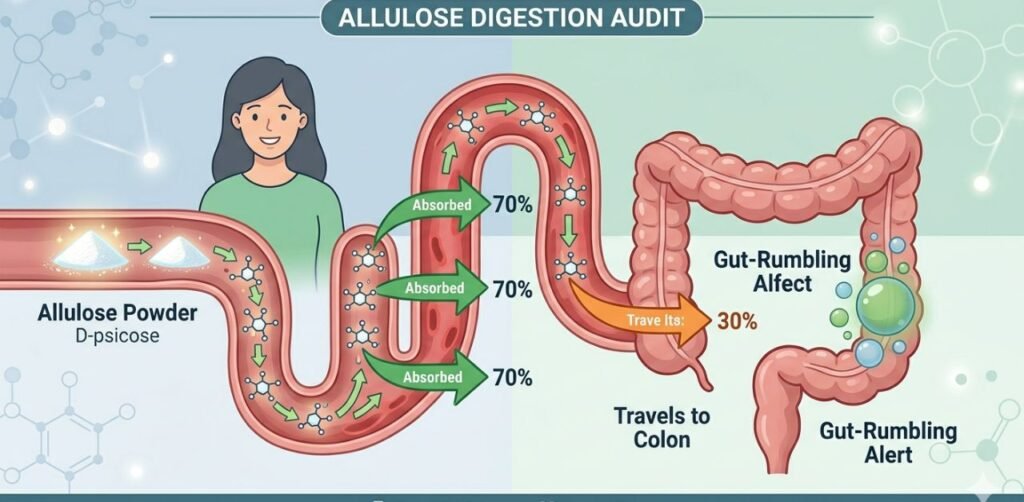
Most people who report allulose side effects are victims of “dosage dumping”—consuming a massive amount before their gut has adapted. In 2026, clinical observations categorize these effects as follows:
- Abdominal Bloating: This occurs when the unabsorbed sugar attracts water into the gut or is fermented by bacteria.
- Osmotic Diarrhea: In high doses, allulose can pull excess water into the colon, leading to loose stools.
- Nausea and Cramps: Some individuals report a “heavy” or “tight” feeling in the stomach shortly after consumption.
| Dosage Level (USA Avg) | Predicted Response | Risk Level |
| 0 – 15g | No noticeable symptoms for 95% of users. | Very Low |
| 15g – 30g | Mild gas or “rumbling” in sensitive individuals. | Low |
| 30g – 50g | Increased risk of bloating and soft stools. | Moderate |
| 50g+ | Likely to cause osmotic diarrhea in most adults. | High |
3. The Gut-Brewery Risk: Allulose and SIBO/Candida
A unique angle that our 2026 audit focuses on is the interaction between rare sugars and pathological gut cultures. Although allulose is not supposed to be highly fermentable, individuals suffering from Small Intestinal Bacterial Overgrowth (SIBO) or Candida may have a different experience.

As we explored in our research on [Gut Auto-Brewery Syndrome], an imbalanced microbiome can turn almost any substrate into a problem. While allulose doesn’t typically ferment into ethanol like complex carbs, it can still feed certain “opportunistic” bacteria in the lower gut. This interaction can lead to:
- Systemic Inflammation: Triggered by bacterial by-products.
- Lethargy: A “heavy” feeling that mimics a post-meal crash.
- Brain Fog: Resulting from the gas pressure and gut-brain axis signaling.
4. The Insulin Sensitivity Myth: Is It Truly Safe?
One of the most persistent questions in the US metabolic community is whether allulose impacts insulin sensitivity over time. Fortunately, current 2026 data shows that allulose might actually improve metabolic health.
Research indicates that allulose can inhibit the enzymes that break down starch into glucose. This means if you eat allulose with a carbohydrate-heavy meal, it acts as a buffer, slowing down the sugar spike. However, this doesn’t mean you should rely on it as a “magic pill.” For long-term health, it is essential to focus on broader [metabolic reset strategies] rather than just swapping one sweetener for another.
5. Allulose vs. Erythritol: The 2026 Comparison
For years, Erythritol was the king of keto. However, after recent studies linked erythritol to increased cardiovascular risks in high-risk individuals, the market has shifted toward Allulose.
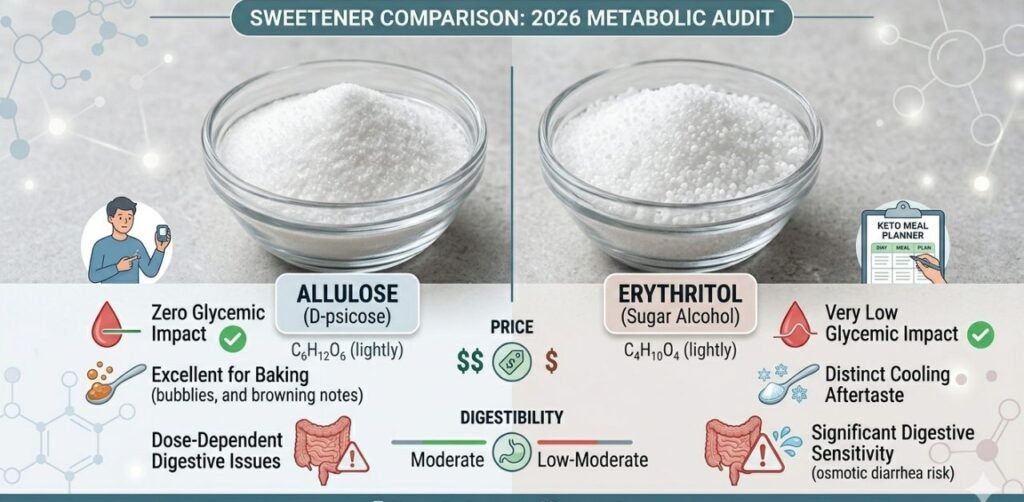
- Digestive Tolerance: Allulose generally has a higher tolerance threshold than sugar alcohols (like Xylitol or Maltitol).
- Taste Profile: It browns and caramelizes like real sugar, making it superior for baking.
- Safety Audit: While allulose side effects are limited to the gut, they are considered far less “toxic” to the metabolic system than synthetic sweeteners like Aspartame or Sucralose.
6. The “Steady-Energy” Protocol: How to Use Allulose Safely
If you want to enjoy the benefits of this rare sugar without the bathroom emergencies, you must follow a strategic approach. Here is our 2026 success protocol for the USA audience:
A. The Titration Method
Do not start with a “sugar-free” pint of ice cream. Instead, start with 5-10 grams (about two teaspoons) in your morning coffee. Gradually increase the dose over two weeks to allow your gut enzymes to up-regulate.
B. The Fiber-First Shield

Just as we discuss in our [Salad Trap audit], fiber protects the gut. Consuming allulose alongside fiber (like a chia pudding or a green smoothie) slows down the transit time, reducing the risk of osmotic diarrhea.
C. The Magnesium Connection
Interestingly, magnesium deficiency can worsen gut sensitivity. Ensuring you have adequate magnesium levels can help your smooth muscles handle the osmotic changes that allulose might trigger.
7. USA Grocery Store Watch: Identifying Hidden Triggers
In the United States, “Allulose” is often part of a blend. You must be an investigative shopper to avoid the worst allulose side effects.
- The Maltodextrin Trap: Many “Allulose Blends” are bulked with Maltodextrin, which has a Glycemic Index of 110. This completely defeats the purpose of using a rare sugar.
- Soluble Corn Fiber Blends: While fiber is good, the combination of soluble fiber and allulose can be a “bloating bomb” for many people.
- Alcohol Sugars: If you see “Allulose + Erythritol” on a label, your risk of digestive upset doubles.
8. Case Study: Sarah’s “Healthy” Keto Fatigue
Sarah, a 35-year-old from Chicago, switched all her sugar to allulose in early 2026. Initially, she felt great, but soon she started experiencing afternoon bloating and a “heavy” stomach.
- The Audit: Sarah was consuming 60g of allulose daily via her coffee, “protein” cookies, and diet sodas.
- The Fix: We reduced her intake to 20g per day and focused on [not all healthy-looking meals are safe] food sequencing.
- The Result: Her bloating disappeared within 48 hours, and her “false fatigue” resolved, proving that dose is the most critical factor.
Ready to optimize your sugar-free lifestyle?
🥗 Open Diabetic Meal Planner & Carb CalculatorPlan your next 2026 metabolic-friendly meal in seconds.
9. FAQ: Solving Your Allulose Mysteries
Q: Can Allulose cause a “mini-hangover” like sugar?
Ans: No. Because it doesn’t ferment into ethanol in significant amounts, it won’t cause the traditional “sugar hangover.” Any fatigue you feel is likely due to gut pressure or dehydration.
Q: Is Allulose safe for children?
Ans: While generally safe, children have smaller guts and lower tolerance thresholds. Limit their intake to avoid severe diarrhea.
Q: Does Allulose raise uric acid levels?
Ans: Preliminary 2026 research suggest that unlike fructose, allulose does not significantly raise uric acid, making it a safer bet for those worried about gout or kidney health.
Conclusion: Reclaiming Your Sweetness
Allulose is undoubtedly a revolutionary tool for those battling insulin resistance and obesity. However, we must treat it with respect. The allulose side effects are real, but they are almost always a result of over-consumption or poor gut health.
By following the “Steady-Energy” protocol and prioritizing whole-food nutrition, you can enjoy the sweetness of life without the metabolic crash. Remember, your sugar substitute is only as good as the diet it supports.
About the Author: Gohar
I am a Metabolic Researcher and the founder of PureDietly.com. My mission is to decode complex 2026 research into actionable steps for the USA health community.
Medical Disclaimer:
The information provided on puredietly.com is for educational purposes only and does not substitute for professional medical advice.