
The Fast-Digesting Carbs Audit: Why Your “Healthy” Snack Is Spiking Your Glucose in 2026
By Gohar Fatima / July 7, 2026
Editorial Note
At PureDietly, our content is audited by metabolic health experts. We prioritize peer-reviewed research and clinical data over wellness trends. Every piece of information in this article has been vetted to ensure it meets our “Zero-Spike” standard for blood sugar management.
The Metabolic Reality: It’s Not Just About Calories
In the modern American grocery landscape, nutrition is often simplified into a numbers game: calories in versus calories out. However, for the millions of individuals managing insulin resistance, Type 2 diabetes, or PCOS, this reductionist view is dangerous. The true metabolic driver isn’t just the energy density of your food; it is the speed at which that food enters your bloodstream.
Welcome to the 2026 Metabolic Audit of fast-digesting carbohydrates. In this deep dive, we move past the marketing labels to look at the biological truth: how specific foods trigger a “glucose spike cycle” and why your body’s response to a bagel is biologically distinct from its response to a bowl of slow-digesting vegetables.
What Are Fast-Digesting Carbs?
Fast-digesting carbohydrates—often called simple or refined carbs—are molecularly simple structures (monosaccharides and disaccharides) that your digestive system can break down and absorb rapidly. Unlike complex carbohydrates, which require a prolonged digestive process, these foods are “fast-tracked” to the bloodstream.
When you consume these items, your pancreas receives an urgent signal: Blood glucose is rising too fast. In response, it floods your system with insulin. For someone with metabolic resilience, this is a manageable task. For someone with insulin resistance, this signal is ignored by the cells, leading to a compensatory surge in insulin (hyperinsulinemia) that keeps the body in a state of high alert and fat-storage mode.
The Glucose Spike Cycle: Why You Feel Tired
The “sugar crash” isn’t just a mood—it is a physiological event. Fast-digesting carbs trigger a rapid peak in glucose, followed by an aggressive insulin response that often overcorrects, dropping your blood sugar lower than it was before you ate. This cycle leads to:
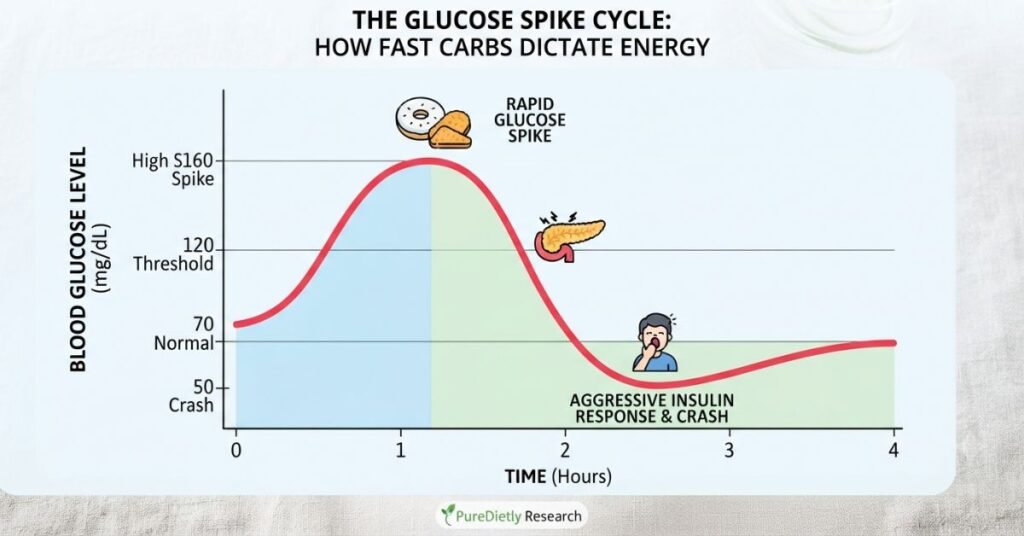
- Pancreatic Exhaustion: Constant demand for insulin reduces the pancreas’s ability to respond efficiently over time.
- Increased Fat Storage: When your cells are insulin resistant, excess glucose cannot be used for energy and is shunted into adipose (fat) tissue storage.
- The “Hunger Trap”: Because the energy from fast carbs is consumed and exhausted so quickly, the brain triggers hunger signals, creating a cycle of constant snacking. Learn more about beating post-meal slumps in our dedicated metabolic audit.
Comparative Audit: Fast vs. Slow
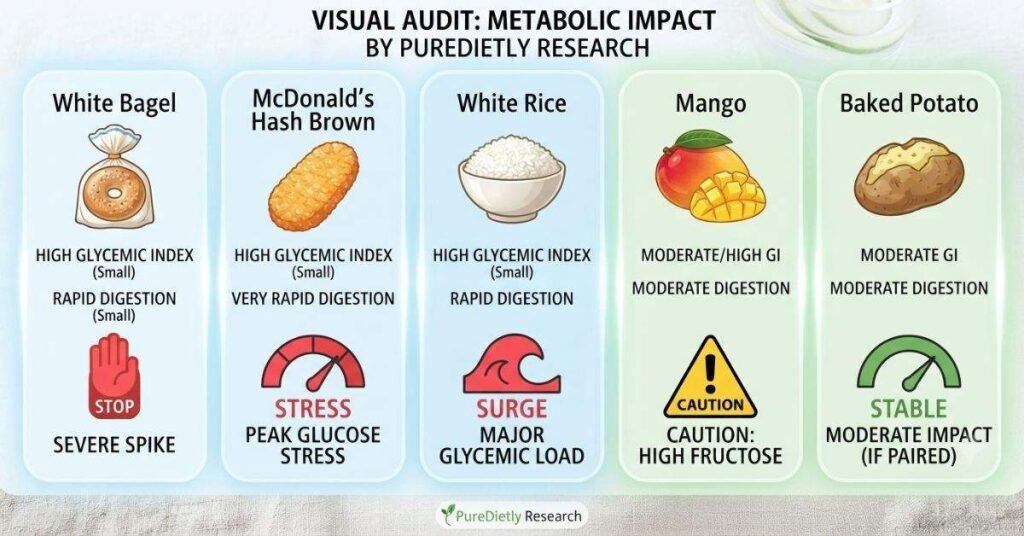
To understand what is happening in your kitchen, we must look at the data. The Glycemic Index (GI) serves as our guide here, ranking foods based on how quickly they raise blood sugar. You can also explore our ranking of the top grains for A1C reduction here.
| Food Item | Glycemic Impact | Metabolic Verdict |
| White Bagel | High | Rapid spike; zero fiber protection. |
| McDonald’s Hash Brown | High | Highly processed starch; systemic stress. |
| White Rice | High | Immediate glucose surge; low nutrient density. |
| Mango | Moderate/High | High fructose load; use caution. |
| Baked Potato | Moderate | Impact is moderated if paired with fat/protein. |
The “Hidden” Trap: Natural vs. Processed
One of the most common pitfalls in diabetic nutrition is the belief that “natural” means “metabolically neutral.” Marketing often uses the word “natural” to justify high price points for products that deliver the same metabolic result: a spike in blood sugar.
Take fruits like mango or pineapple, or natural sweeteners like honey. While they are not “processed” in the sense of high-fructose corn syrup, they contain significant amounts of free-floating glucose and fructose. If you are highly insulin resistant, your pancreas does not care if the glucose came from a bag of refined white sugar or a tree-ripened fruit; it will still trigger an insulin response to manage the sudden load.
The “Zero-Spike” Kitchen Protocol
You do not need to live in a world of restrictive eating. Instead, you need Metabolic Autonomy. You can enjoy carbohydrates by modifying your consumption protocol. See our guide on the best time to eat carbs for insulin resistance to optimize your timing.

- The Fiber-First Rule: Before eating any carbohydrate, consume a serving of fibrous, non-starchy vegetables. Fiber creates a physical “net” in your digestive tract that slows down the absorption of glucose, significantly blunting the spike.
- The Protein/Fat Anchor: Never eat a “naked” carb. If you are going to eat a slice of sourdough bread or a portion of rice, anchor it with a high-quality protein and a healthy fat.
- Strategic Timing: Use fast-digesting carbs as “performance fuel.” During exercise, your muscle cells become more sensitive to insulin, allowing them to pull glucose from the blood for repair without requiring the massive insulin surge typically seen during sedentary periods.
Why Personal Data Matters: The CGM Insight
If you are serious about auditing your metabolic health in 2026, stop guessing. The most transformative tool at your disposal is a Continuous Glucose Monitor (CGM).
I personally audited my habits using a CGM for 30 days. Your body’s response is unique. Your genetics, gut microbiome, and stress levels all play a role in how you handle a bagel versus a baked potato. Use data to audit your personal metabolic response.
Addressing the Myths: Can You “Burn Off” a Spike?
A common myth is that if you go for a walk after eating a fast-digesting carb, you negate the spike. Understanding the science of the 90-minute post-carb crash is key, as prevention is always superior to mitigation. Aiming to avoid the spike in the first place is the foundation of long-term insulin sensitivity.
Conclusion: Your Metabolic Autonomy
Building metabolic resilience is a journey, not a destination. By moving away from “fast-digesting” habits and toward a protocol centered on fiber, protein, and glucose-stable alternatives, you take control of your metabolic autonomy.
Frequently Asked Questions (FAQ)
- Are all fast-digesting carbs harmful?
- No. They can be utilized as “performance fuel” by athletes or active individuals during post-workout recovery.
- How much fiber do I need to blunt a glucose spike?
- Starting a meal with a significant portion of fibrous vegetables is a proven way to reduce the glycemic impact.
- Is the Glycemic Index (GI) always accurate?
- The GI is a helpful tool, but it is not absolute. Factors like food pairing and your personal metabolic health mean your response may differ.
- Why is my blood sugar still high if I eat “healthy” natural sugars?
- The body breaks down natural sugars into glucose and fructose just as it does with refined sugars. If you have underlying insulin resistance, these can still trigger a response. Check out our complete beginner’s guide for a low-carb diet to learn how to manage these effectively.
About the Author: Gohar Fatima

Metabolic Health Researcher & Founder of PureDietly
I am Gohar Fatima, the founder of PureDietly and a dedicated Metabolic Health Researcher specializing in Clinical Nutrition and Glycemic Variability. My journey began with a singular mission: to strip away the confusion surrounding diabetic nutrition. I founded PureDietly to provide evidence-based, actionable strategies for individuals navigating insulin resistance, glycemic control, and metabolic resilience.
Medical Disclaimer
The information on PureDietly is for educational purposes only and is not a substitute for professional medical advice, diagnosis, or treatment. Always consult your physician or a qualified healthcare provider regarding your specific diabetes management plan.